Use Instructions

Quick Start Guide

1

Confirm the fit and mount the TipTopTemp.

Use the mounting setup for your grill or smoker. The TipTopTemp should sit securely over the upper vent so the majority of air flow passes through the controller and unwanted air leaks are minimized. It does NOT need to be airtight.

TipTopTemp mounted on a Big Green Egg
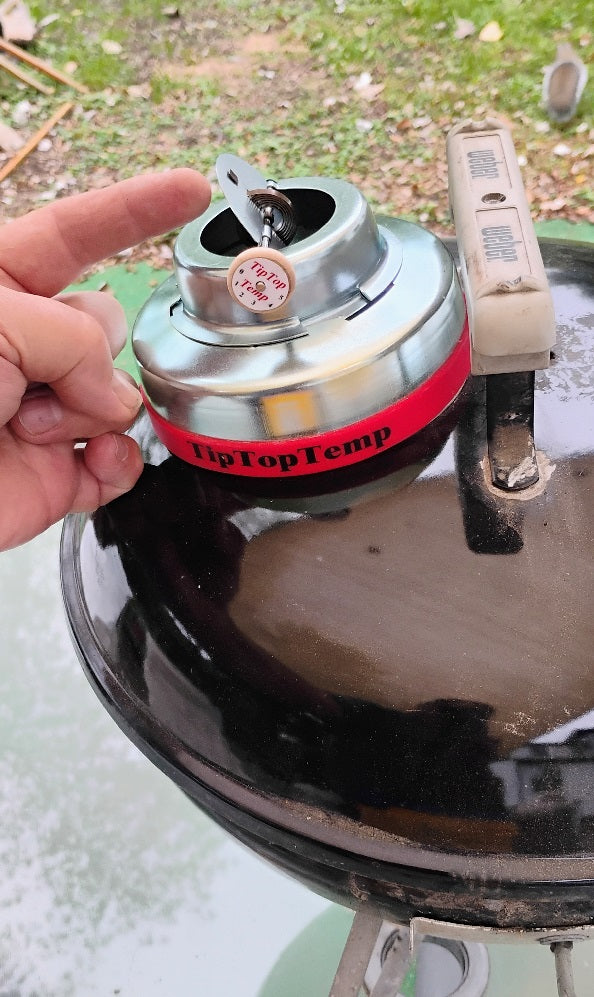
Mounted on a Kettle grill.
2

Start with a small, controlled fire.

Start with a small, manageable fire. A large, fully established fire is much harder to control and can drive the grill or smoker past the target before the TipTopTemp has a chance to settle it.

Why it matters: The T3 limits airflow. It works best when it is regulating a controlled fire rather than trying to recover from a large overshoot.
3

Warm up with the damper open.

Close the grill lid and use the knob to open the TipTopTemp damper while warming up. Do not force or overturn the knob. The damper may need to be opened again as the grill temperature rises.

TipTopTemp T3 damper and adjustment knob
4

About 50°F below target, close the damper to roughly one quarter open.

As the grill or smoker approaches the temperature you want, use the knob to reduce the opening before you reach the target. Then give the TipTopTemp and the grill or smoker time to settle instead of chasing the temperature with constant adjustments.

Example: For a 250°F target, begin settling the damper at roughly 200°F rather than waiting until the grill is already at or above 250°F.
5

Fine tune with small changes, then wait.

Adjust the TipTopTemp only as needed. Grills and smokers respond slowly, so allow several minutes between adjustments before deciding whether another change is necessary.

Real T3 damper movement.
6

Use the lower vent as needed for your grill.

The TipTopTemp controls airflow at the top. Varying grill designs or higher target temperatures, may require more air by slightly opening the lower vent. Use a test cook to learn what is best for your grill.

Remember: If the T3 is open and the temperature is still falling, the fire may need more intake air from the lower vent.
Cleaning & Maintenance

Keep the damper moving freely.

Cooking residue can build up around the moving parts. Clean away residue or buildup and make sure the damper moves freely before each cook.

Watch for buildup

Check the moving parts for cooking residue or buildup, especially if the damper begins to feel sticky or does not move freely. Wet fuel and sauces can create sticky film during the cook. Wipe the TipTopTemp damper edge if you see a wet film before it dries.

Clean as needed

A dishwasher or a light brushing after warm soapy soak will remove dried residue that interferes with movement. Avoid forcing the damper or adjustment knob while cleaning or checking the mechanism.

Check before use

Before the next cook, make sure the damper moves freely and the TipTopTemp sits securely on your grill or smoker.

Troubleshooting

If the temperature is not settling where you want it.

Temperature is falling

If the TipTopTemp is open and the temperature is still falling, the fire may need more intake air from the lower vent.

Temperature keeps rising

Check for open lower vents, avoid opening the lid, and use the knob to close the TipTopTemp damper, the temperature should fall. If all else fails, start over by CAREFULLY remove lit coals, leaving 1 or 2 for the new setup.

Damper is not moving freely

Check for cooking residue or buildup around the moving parts and clean the mechanism.